
The Different Camera Focus Modes and When to Use Them
One of the most important aspects of photography is getting a sharp picture. And to get a sharp picture, you need to know which camera focus modes will work best for your needs. There are three types: autofocus area mode, continuous autofocus and manual focus. Autofocus area mode works by automatically selecting an object in the foreground or background, while continuous autofocus continually adjusts as you change composition from one shot to another. Manual focus gives you full control over what’s in focus. When should each be used? Read on and find out!

What’s the difference between manual focus and autofocus?
What is MF in Camera?
Manual Focus Mode (MF) is where you manually adjust a lens’ focus ring to set the focus distance of your lens. This is best used in scenarios where you want to control what’s in focus, rather than have the camera do it automatically (like when shooting a portrait).Manual focus mode is usually more reliable than autofocus when shooting in low-light conditions like astrophotography and in some other genres like macro, architecture, and stills.
What is AF in Camera?
Autofocus Mode – (AF) is where the camera automatically determines what’s in focus. This is best for shooting close-ups of a subject that’s not moving, or if you’re using autofocus continuous mode (AF-C), which continually adjusts as you change composition from one shot to another. Selecting the best focus mode depends on your subject.
Is Autofocus mode better than Manual?
Autofocus mode is different from manual, not better. Manual mode is best used when you know precisely what you want in focus and you can’t rely on the camera autofocus mode, like, for example, in low-light conditions. For moving subjects, Autofocus is usually more convenient than manual.
What are the Camera Autofocus (AF) Modes?
Single autofocus mode (AF-S / One-Shot AF)
Single autofocus or One-shot AF is designed to work with stationary subjects that don’t move and can be fired without waiting for the autofocus system. It allows you to select a single focus point for static elements within the scene. So long as you keep the subject framed over this point and are using AF-C, the camera will automatically adjust focus to keep the sharpness of the image. Basic Camera models include just a few focus points where you can select your single-point area, where as more expensive camera models have more for you to choose from.
Continuous autofocus mode (AF-C or AI Servo)
This is best used when you’re tracking a moving subject, like shooting sports or wildlife (yes, that includes your kids 😉), as it’s designed to focus on one point at any given time while continually refocusing until the shutter button is pressed. Continuous AF works better in low light environments where there are more obstacles between your camera and your subject.
What is the Difference Between AF-S and AF-C?
AF-S is designed for still images and AF-C is used in situations where you are tracking a moving subject.Hybrid autofocus mode (AF-A / AI Focus AF)This is a mix of automatic and continuous autofocus modes. AF-A will automatically select either single or continuous focus, depending on the subject matter and camera settings; AI Focus mode uses artificial intelligence to figure out what’s in your photo frame before deciding whether it should be focusing on foreground movement (single), background movement (continuous) or both (continuous).
Eye AF
Eye autofocus points are available on cameras with dual-lens autofocus and zoom lenses. Eye AF base their decision to focus by looking for eye contact from within the frame, which is helpful when you’re photographing a person’s face or they are in an otherwise well lit environment – but it can be fooled if there’s someone else at centre of your image.
What Focus Mode Should I use?
It depends, but for beginners who want to set it and forget it you can’t go wrong with AF-A. Otherwise, think about your subject and ask if it’s still AF-S or moving AF-C.

How do I Change Autofocusing Modes?
Press the menu button on your DSLR then use left/right controls or directional arrows to scroll through different modes:
Single Area AF, Dynamic Area AF, Face Detection Autofocus Mode etc.)
What are AutoFocus Points and Areas?
These are individual focus areas that you can select on the rear of your camera, and it will focus exclusively on whatever target you select as its primary location within the shooting frame.
What is a focus point?
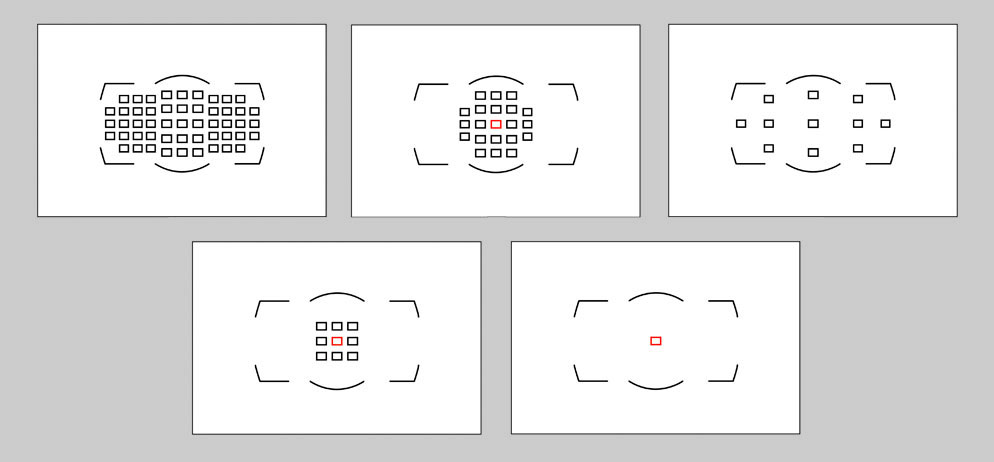
These rectangles / circle in your viewfinder indicate where focusing occurs, but do not actually provide an indication of what will show up within the frame.A focus point lets you to choose a single point in the frame to autofocus on, and it will only lock on that target. Depending on your camera model you’ll have a varying amount of focus points to choose from. In general, the more focus points your camera has the better. The number of autofocus points can vary from as little as one to over a thousand in some cameras, so it’s important to know what you’re getting into before deciding on a model or brand.
- Entry level DSLR’s have either 9 or 11 focus points.
- Mid range DSLR’s have 45 or 51 focus points.
- Full frame camera’s like Sony’s A7 Mirrorless has Hybrid with 693 phase detection points and 425 contrast detection points while the Canon 1DX has 191 focus points the Canon R6 has 1053.
Types of Autofocus Points
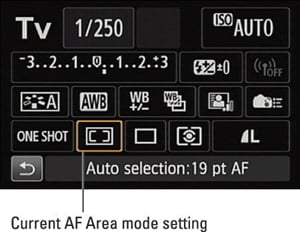
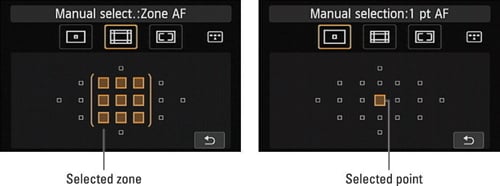
There are different types of AF points: vertical or horizontal, and cross-type. Vertical AF points detect contrast on vertical lines, whereas cross-type analyse both vertical and horizontal lines together. As a result, cross-type AF points are more accurate and have a greater ability to retain focus, but they are more expensive.The camera can only focus where there is an AF point, and cameras with fewer points will have a harder time achieving and maintaining accurate focus as the gaps between each point are larger. You could think of the areas of the scene not covered by AF points as ‘blur zones’.What is the Autofocus Area Zone Mode?Autofocus Area mode (AF-A) uses multiple focus points at one time to determine what’s in focus. The system determines which of these has priority based on subject movement and composition. Dynamic AF area or Zone AF allows you to manually select a zone for the camera to autofocus on. While Group AF ensures autofocus accuracy when a single spot AF isn’t enough. This is most used in group subjects like wildlife and sports. Alternatively, if you’ve got a headache by this point you can also stick with full autofocus. However, you camera will be choosing what to focus on, and it doesn’t always get it right.Pro Tip: reframe you composition or press the shutter half down again and it will rethink.Canon focus points
Nikon Focus Areas
How to Combine Autofocus Modes With Focus Areas for Better Photos?
Now it’s time to put the Autofocus modes and auto focus area together.
- Single point area and AF-S mode
- Dynamic Area and AF-C mode is perfect
How to Autofocus in Live View or on your smartphone?
Simple tap where you want to focus. Live view focusing is slower, but is more accurate for static subjects.
What is back focus?

Back button focus is when a photographer focuses the lens separate to the shutter button so that autofocus doesn’t keep retargeting for every shot.
Why won’t my camera focus?
The main causes for your camera not to focus correctly are;
- may be something obstructing the lens, ie dust or lint between your lens and camera connection points
- Your lens or camera is on manual focus
- You’re too close to the subject. Each lens has a minimum focus distance which is required to focus.
- Your subject moved too quickly.
- Your shutter speed is too slow
- The scene is too dark, and there isn’t enough contrast for the camera to focus on.
When you’re in manual focus mode on your camera, it can be difficult to achieve a perfect sharp focal point. You’ll need to experiment and learn more about the different types of focus modes available (AF-S, AF-C), how each works best for certain situations, and troubleshoot any problem that may arise. The key is knowing which type of focus mode will work better for what situation so you don’t have to guess or search through all the settings! Share this blog post with a friend who loves photography if you found these tips helpful. We hope they help make capturing those perfect sharper shots easier than ever before!
Have any questions or feedback?


